Published
- 5 min read
Artificial Plant Maintenance: Keep Your Faux Greenery Looking Real Forever
Artificial Plant Maintenance: Keep Your Faux Greenery Looking Real Forever
One of the biggest selling points of artificial plants is that they are “low maintenance.” While this is true—you don’t have to water them, feed them, or worry about sunlight—it is a mistake to think they are zero maintenance. As an interior designer, the saddest thing I see in a home is a beautiful, high-quality faux tree that has been allowed to become a dusty, faded, flat-looking relic.
A neglected fake plant is a dead giveaway of its artificiality. Dust obscures the natural luster of the leaves, while UV damage can turn a vibrant jungle green into a sickly blue-gray. To keep your home looking fresh and your “botanical illusion” intact, you must perform regular upkeep.
In this ultimate maintenance guide, I will share my professional toolkit and techniques for cleaning, “fluffing,” and protecting your artificial plants, featuring the best maintenance products available on Amazon.
The Maintenance Philosophy: Preserving the Illusion
In nature, plants are constantly changing. They grow, they get rained on, and they move in the wind. Artificial plants are static. Maintenance is the process of mimicking that natural freshness.
- Dust Management: Dust is the #1 enemy of realism.
- Structural Integrity: Gravity and time can cause branches to sag.
- Color Preservation: Sunlight is a slow poison for plastic and silk.
Step 1: The “Unboxing” and Initial Fluffing
Maintenance starts the moment your plant arrives. Most Amazon artificial plants are shipped “compressed.”
- The 20-Minute Rule: Never just pull a plant out of the box and place it. Spend at least 20 minutes working every branch.
- The “Natural Curve” Technique: Stems should never be straight. Real plants grow in curves as they reach for the light. Use the internal wire to create gentle “S” curves in the main branches.
- Reference Photos: Keep a photo of the real species (like a real Ficus or Olive Tree) on your phone while you fluff. Mimic the way the leaves cluster and the angle at which they meet the stem.
Step 2: Cleaning Techniques for Every Material
Different faux plants require different cleaning methods depending on whether they are made of silk, polyester, or “real-touch” polymers (PE/PU).
1. For Broad, Waxy Leaves (Fiddle Leaf, Monstera, Snake Plant)
These are the easiest to clean.
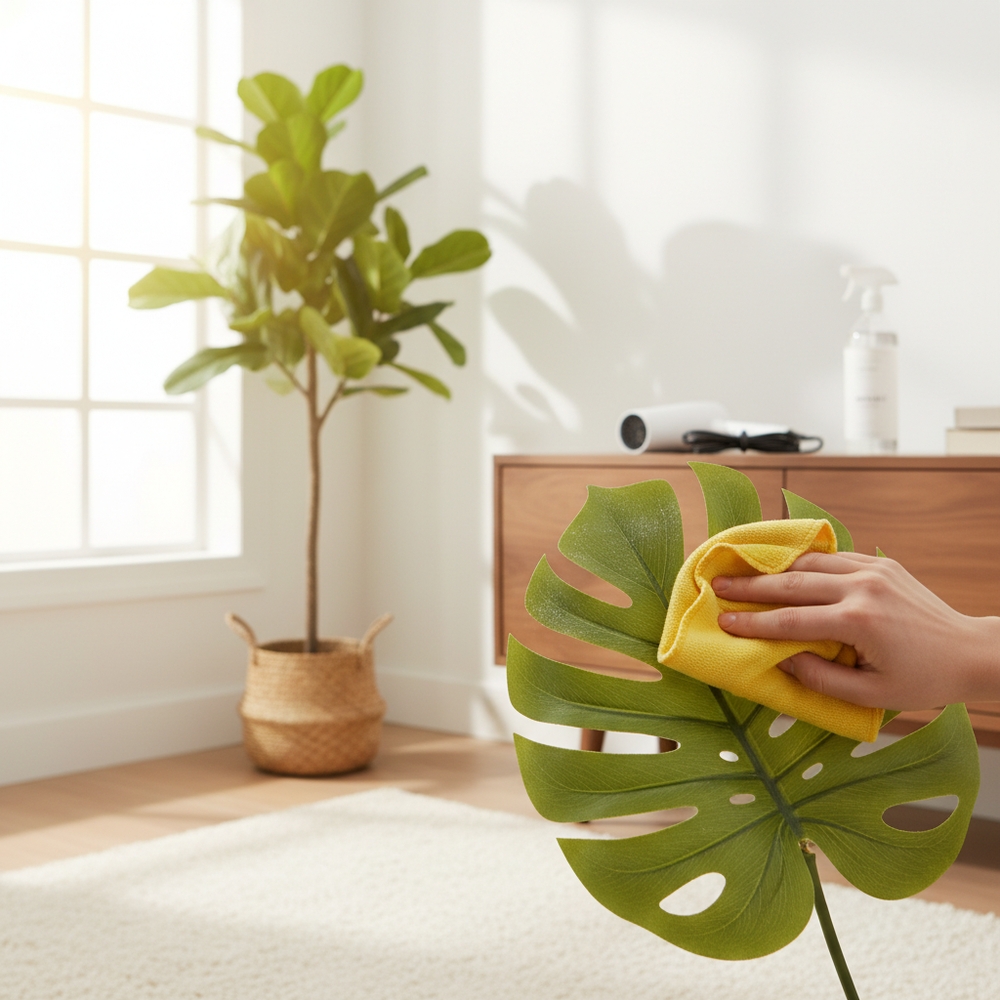
- The Microfiber Method: Use a dry microfiber cloth to remove bulk dust once a week.
- The Deep Clean: Once every three months, use a damp cloth with a tiny drop of mild dish soap. Wipe both the top and the underside of every leaf. This restores the natural sheen.
- Affiliate Pick: Amazon Basics Microfiber Cleaning Cloths (24-Pack)
2. For Delicate or Small Leaves (Olive Trees, Ferns, Boxwood)
Wiping individual leaves on an Olive tree is impossible.
- The Hairdryer Trick: Use a hairdryer on the cool, low setting to blow dust out of the interior of the plant. This is highly effective for ferns and dense topiaries.
- The “Shower” Method: For high-quality plastic (PE) plants, you can actually take them into the shower. Use lukewarm water and a gentle spray. Note: Do NOT do this with silk plants, as the water can cause the dyes to bleed or the glue to dissolve.
3. For Silk Flowers and Delicate Stems
- The Salt Bag Method: Place the artificial flower heads in a large paper bag with a cup of table salt. Shake gently for one minute. The salt acts as a mild abrasive that “scrubs” the dust off the delicate fabric without damaging it.
Step 3: Protecting Against UV Damage
If your artificial plant sits in a sun-drenched living room or on an outdoor porch, it is at risk of “photo-degradation.”
- UV Protective Sprays: This is like sunscreen for your plants. It creates a clear, matte film that blocks harmful rays.
- The “Rotate” Rule: Even if a plant is faux, rotate the pot 90 degrees every month. This ensures that if any fading does occur, it happens evenly rather than only on one side.
- Affiliate Pick: Tri-Coastal UV Protector Spray for Artificial Plants
Step 4: Restoring Life to “Sad” Plants
If your faux plant has been in storage or has lost its shape, you can use heat to “reset” the material.
- Steam Treatment: Use a handheld garment steamer to gently heat the leaves of silk or polyester plants. This removes wrinkles and allows you to reshape the fabric more easily.
- The “Matte Sealer” Trick: If your fake plant has developed a “plastic-y” shine over time, a light coat of Matte Clear Spray Sealer can restore that sophisticated, natural look.
Your Maintenance Schedule
| Frequency | Task |
|---|---|
| Weekly | Quick dusting with a microfiber cloth or feather duster. |
| Monthly | Cool-air blast with a hairdryer; check for sagging branches. |
| Quarterly | Deep wipe-down with a damp cloth (for broad leaves). |
| Yearly | Re-apply UV protective spray; “re-fluff” the entire structure. |
Conclusion
Artificial plants are a brilliant investment in your home’s aesthetic, but they require a tiny bit of love to stay looking their best. By following this expert maintenance routine—focusing on regular dusting, proper fluffing, and UV protection—you can ensure that your faux greenery remains a vibrant, realistic, and beautiful part of your home for decades. A clean plant is a real-looking plant.