Published
- 6 min read
The Best Pots and Planters for Fake Plants: Choosing the Foundation for Realism
The Best Pots and Planters for Fake Plants: Choosing the Foundation for Realism
As an interior designer, I often tell my clients: a fake plant is only as good as the pot it sits in. You can spend $300 on the most hyper-realistic, real-touch Fiddle Leaf Fig on the market, but if you leave it in that tiny, flimsy black plastic “nursery pot” it was shipped in, you are immediately signaling to every guest that the plant is artificial.
The container is the “foundation” of the illusion. In nature, a 6-foot tree requires a substantial root system and a correspondingly large volume of soil. When we see a large plant in a tiny pot, our brains subconsciously flag it as “fake.” By choosing the right decorative pot, basket, or planter—and “planting” your faux greenery correctly—you provide the visual weight and context needed to sell the lie.
In this comprehensive guide, I will show you how to choose the best pots and planters for your artificial plants, featuring top-rated Amazon finds that will elevate your decor from “craft store” to “designer showroom.”
Why the “Nursery Pot” Must Go
Most high-end artificial plants come with a “weighted base”—a small black plastic pot filled with concrete. This is designed for stability during shipping and to act as an anchor, not as a finished decorative element.
- Scale and Proportion: A large plant needs a large pot. Upgrading the size of the container makes the plant feel more established and “grown.”
- Texture and Material: Real plants are found in organic materials like clay, stone, wood, and fiber. Moving your faux plant into these materials bridges the gap between synthetic and natural.
- Style Integration: The pot is your opportunity to tie the plant into your room’s specific aesthetic—be it Mid-Century Modern, Boho, Industrial, or Coastal.
Top 4 Planter Styles for Artificial Plants
Each type of artificial plant requires a different “root” aesthetic. Here are the professional’s top choices.
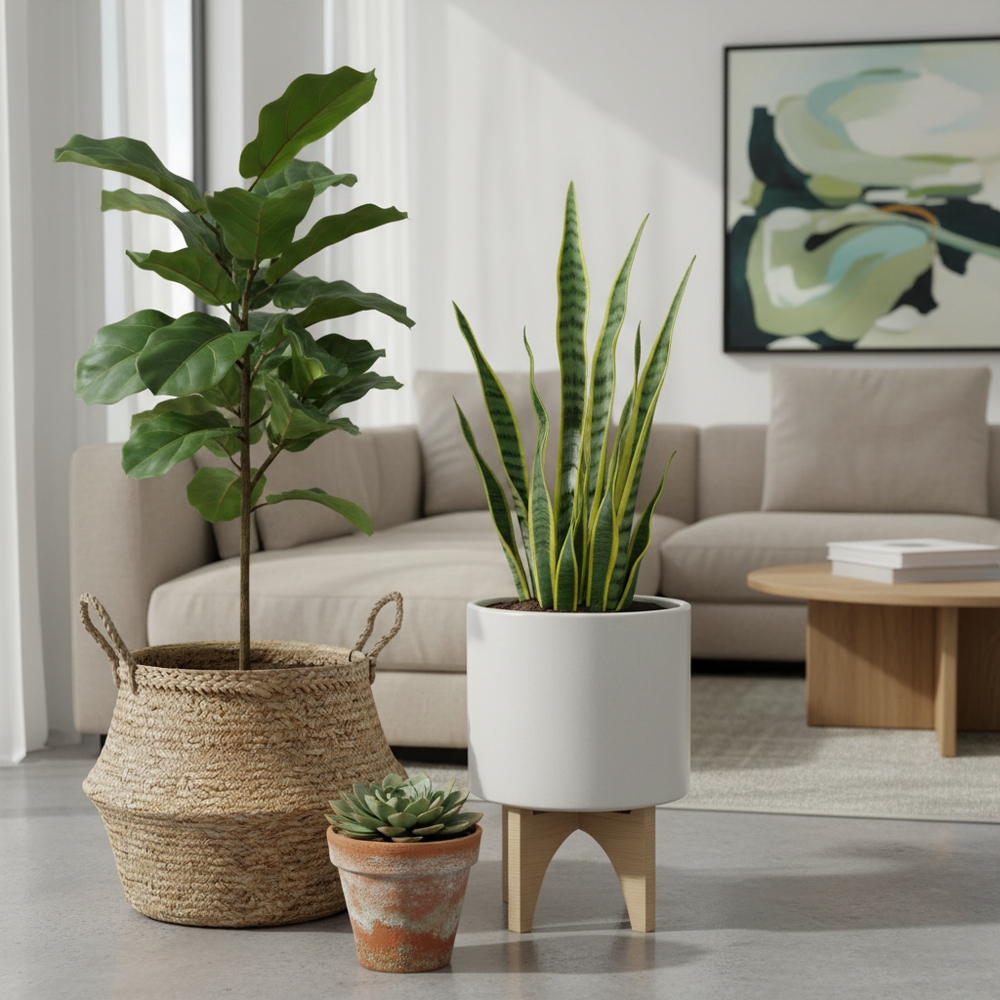
1. The Boho & Coastal Favorite: Woven Seagrass Baskets
Baskets are the perfect way to add warmth and softness to a room. They are especially effective for large floor plants like Palms, Ficus, and Fiddle Leaf Figs.
- Why it works: The organic, irregular weave of seagrass or jute provides a beautiful contrast to the smooth leaves of artificial plants.
- Styling Tip: Baskets are “soft,” so you must use a rigid internal liner (like a plastic bucket) or heavy weights to ensure the plant doesn’t lean or wobble inside.
- Get it on Amazon: La Jolie Muse Seagrass Planter Basket
2. The Mid-Century Modern Classic: Ceramic Pots with Wooden Stands
If you want a clean, architectural look, a cylinder ceramic pot on a walnut or oak stand is the gold standard.
- Why it works: The height provided by the stand allows you to make a shorter faux plant (like a 3ft Snake Plant) look much more substantial and “designer.”
- Styling Tip: This style works best with upright plants like Snake Plants, Dracaena, or large-leafed Monsteras.
- Get it on Amazon: Fox & Fern Mid-Century Planter with Stand
3. The Industrial & Minimalist Choice: Concrete or Stone Planters
For a grounded, high-end look, nothing beats the weight and texture of real stone or “lightweight” concrete.
- Why it works: Concrete planters have a “permanent” feel. Because they are heavy, they are also the best choice for preventing pets or children from knocking over your tall faux trees.
- Styling Tip: Use gray or charcoal concrete to make the vibrant green of your plants really “pop.”
- Get it on Amazon: Kante Lightweight Concrete Modern Planter
4. The Tabletop Essential: Aged Terracotta Pots
For small herbs, succulents, or trailing ivy on a bookshelf, real terracotta is unbeatable.
- Why it works: Terracotta is porous and develops a beautiful “patina” over time. Even a fake plant looks real when it’s sitting in a pot that looks like it’s been in a garden for years.
- Styling Tip: Look for “aged” or “distressed” terracotta to avoid that bright orange “new” look.
- Get it on Amazon: Deroma Standard Terracotta Pot Set
Expert Tutorial: How to “Plant” Your Faux Greenery
Simply dropping the black plastic base into a pretty pot isn’t enough. You need to “install” the plant. Follow these four professional steps.
Step 1: The “Height Adjustment”
Place your faux plant inside the new decorative pot. Is it too low? A common mistake is letting the plant sit too deep. Use bricks, blocks of wood, or upside-down plastic nursery pots to raise the plant so that the top of its base is about 2-3 inches below the rim of the decorative pot.
Step 2: Stability and Centering
Once the height is right, use crumpled newspaper, cardboard, or bubble wrap to fill the gaps between the internal base and the walls of the decorative pot. This ensures the plant stays perfectly vertical and doesn’t shift if someone bumps into it.
Step 3: The “Soil” Layer
This is the most important step for realism. You must cover the internal mechanics with a “real” top layer.
- For a natural look: Use real potting soil or dark wood mulch.
- For a clean look: Use real preserved sheet moss or Spanish moss.
- For a modern look: Use polished river rocks or white lava stones.
- Affiliate Pick: SuperMoss Preserved Sheet Moss
Step 4: The Final Fluff
Now that the “roots” are set, spend 10 minutes bending and shaping the branches. Remember: nature isn’t perfect. Bend some branches more than others, and ensure the leaves are angled toward where your room’s “sunlight” would be coming from.
Pro Tip: Scaling Your Planter
When in doubt, go bigger. A small plant in a large pot looks like a “young” plant that is thriving. A large plant in a small pot looks like a fake plant that has outgrown its synthetic home. As a general rule, the decorative pot should be at least 2-4 inches wider than the black base the plant came with.
Conclusion
Choosing the right pot is the final 20% of work that provides 80% of the realism for your artificial plants. By moving your greenery out of the shipping plastic and into high-quality baskets, ceramic, or stone containers, you create a cohesive, high-end look that anchors your room. Don’t let a beautiful faux tree be ruined by a bad foundation—invest in a quality planter and “plant” it with intention.